
Why Do Autistic People Stim? Understanding the Science Behind Self-Regulation
As an autistic person, one of the most common criticisms I receive is about my stimming.
People have told me to stop shaking my leg, rocking in my chair, fidgeting with objects, or pacing while I think. Sometimes those comments are well-intentioned. Other times they come from frustration or discomfort. Regardless of the intention, the message is usually the same:
"Can't you just stop?"
The honest answer is no.
For years, I tried.
Like many autistic people, I believed that fitting in meant hiding the ways my body naturally regulated itself. I stopped myself from rocking. I kept my hands still. I sat on my hands during meetings. I resisted the urge to pace while I thought.
From the outside, it probably looked like I had developed better self-control. On the inside, I was becoming more anxious, more distracted, and increasingly exhausted.
It took me a long time to understand why.
As I learned more about autism—including neuroscience, sensory processing, predictive coding, and the lived experiences of other autistic people—something finally clicked.
The behaviors I had spent years trying to suppress weren't getting in the way of my functioning. They were helping my nervous system regulate itself.
In other words, stimming wasn't the problem. It was part of the solution.
That realization completely changed how I understood myself—and, ultimately, how I practice therapy.
So instead of asking,
"How do we stop stimming?"
I think we should ask a different question:
What purpose is stimming serving?
Autism Is More Than What We Can See
When many people think about autism, they focus on what they can observe:
• Differences in communication
• Repetitive behaviors
• Difficulty with change
These are certainly part of autism, but they only tell us what someone looks like from the outside. They don't tell us what the world feels like from the inside.
That's understandable. Behavior is what we can see.
But behavior alone doesn't tell us why it's happening.
One of the most important—and often overlooked—aspects of autism is sensory processing. Research suggests that sensory differences affect the vast majority of autistic people and shape how we experience and interact with the world around us.
For example, some autistic people experience:
• Fluorescent lights as physically painful
• Background sounds that most people automatically tune out
• Clothing tags or certain fabrics that become impossible to ignore
• Strong smells, such as perfume, that can trigger nausea or headaches
• Crowded environments that become overwhelming long before anyone else notices
At the same time, many autistic people actively seek sensory experiences because they help us feel calmer, more organized, and better able to think. These might include:
• Deep pressure
• Rocking or rhythmic movement
• Music or repetitive sounds
• Certain textures or objects to fidget with
These experiences aren't contradictory. They're two ways the nervous system works to find balance.
They're also not fixed. A busy grocery store that feels manageable one day may feel overwhelming the next. Stress, lack of sleep, illness, or an already overloaded nervous system can all change how much sensory input a person can comfortably process.
When we begin by understanding sensory experience instead of focusing only on outward behavior, autism starts to make a lot more sense.
Instead of asking,
"Why is this person behaving this way?"
we can ask,
"What might this person be experiencing?"
Your Brain Is Constantly Making Predictions
Here's something that surprised me when I first learned it:
Your brain isn't simply reacting to the world around you.
It's constantly making predictions about it.
Imagine reaching for your front door.
Before your hand even touches the handle, your brain has already predicted how cool the metal will feel, how much pressure it will take to turn it, and what will happen when the door opens.
When those predictions are correct, your brain barely notices.
But imagine the handle suddenly feels warm.
Or sticky.
Immediately, your brain pays attention. It asks:
"Something changed. What happened?"
Neuroscientists call this predictive coding. It's one way the brain reduces mental effort. Instead of analyzing every sensation from scratch, it uses past experience to predict what is likely to happen next and decide which information needs attention.
Some researchers believe autistic brains place greater emphasis on what is happening right now than on what was expected to happen. Rather than filtering as much sensory information automatically, more of that information may remain available for conscious processing.
This can be an incredible strength.
Many autistic people notice patterns others miss, detect subtle changes, and excel at detail-oriented thinking.
But it can also mean the brain has to work much harder to process the constant stream of incoming information.
When Your Nervous System Starts Running Out of Capacity
Imagine trying to have a conversation while simultaneously noticing:
• The buzzing fluorescent lights overhead
• The humming refrigerator
• Someone tapping their foot across the room
• The texture of your clothing
• The smell of someone's perfume
• Multiple conversations happening nearby
For many autistic people, that isn't an exaggeration. It's an ordinary part of daily life. Each individual sensation may require only a little extra processing. But throughout the day, they accumulate.
I often compare it to having dozens of apps open on your phone. One app isn't a problem.
Twenty apps all running at the same time?
Eventually, the battery drains, the phone slows down, and everything becomes harder. Our nervous systems aren't that different.
As more sensory information demands attention, less mental energy remains for conversation, decision-making, emotional regulation, planning, or even remembering why you walked into the room.
Eventually, the nervous system reaches its limit.
This is what we call sensory overload.
Sensory overload happens when the brain becomes overwhelmed by more sensory information than it can process. This triggers a real, physical stress response in the nervous system. It is not a choice, bad behavior, or a lack of self-control—it is an automatic biological response to overwhelming sensory input.
If sensory energy continues to build without an opportunity to be processed or released, it will eventually reach a breaking point. This can result in an autistic meltdown—an outward explosion of pent-up sensory energy—or an autistic shutdown—an inward implosion of sensory energy as the brain retreats into a protective survival state. Both are involuntary responses to extreme sensory overwhelm and can be physically and emotionally exhausting, deeply distressing, and even traumatic for the person experiencing them.
A meltdown or shutdown isn't evidence that someone "failed to cope."
It's often evidence that they've been coping for far longer than anyone realized.
So Why Do Autistic People Stim?
Once we understand sensory processing, stimming begins to make sense.
Stimming—short for self-stimulatory behavior—includes repetitive movements, sounds, or actions that provide predictable sensory input.
Examples include:
• Rocking
• Pacing
• Hand flapping
• Humming
• Listening to the same song on repeat
• Chewing gum
• Tapping your fingers
• Sucking on a straw
• Running your hand across a favorite fabric
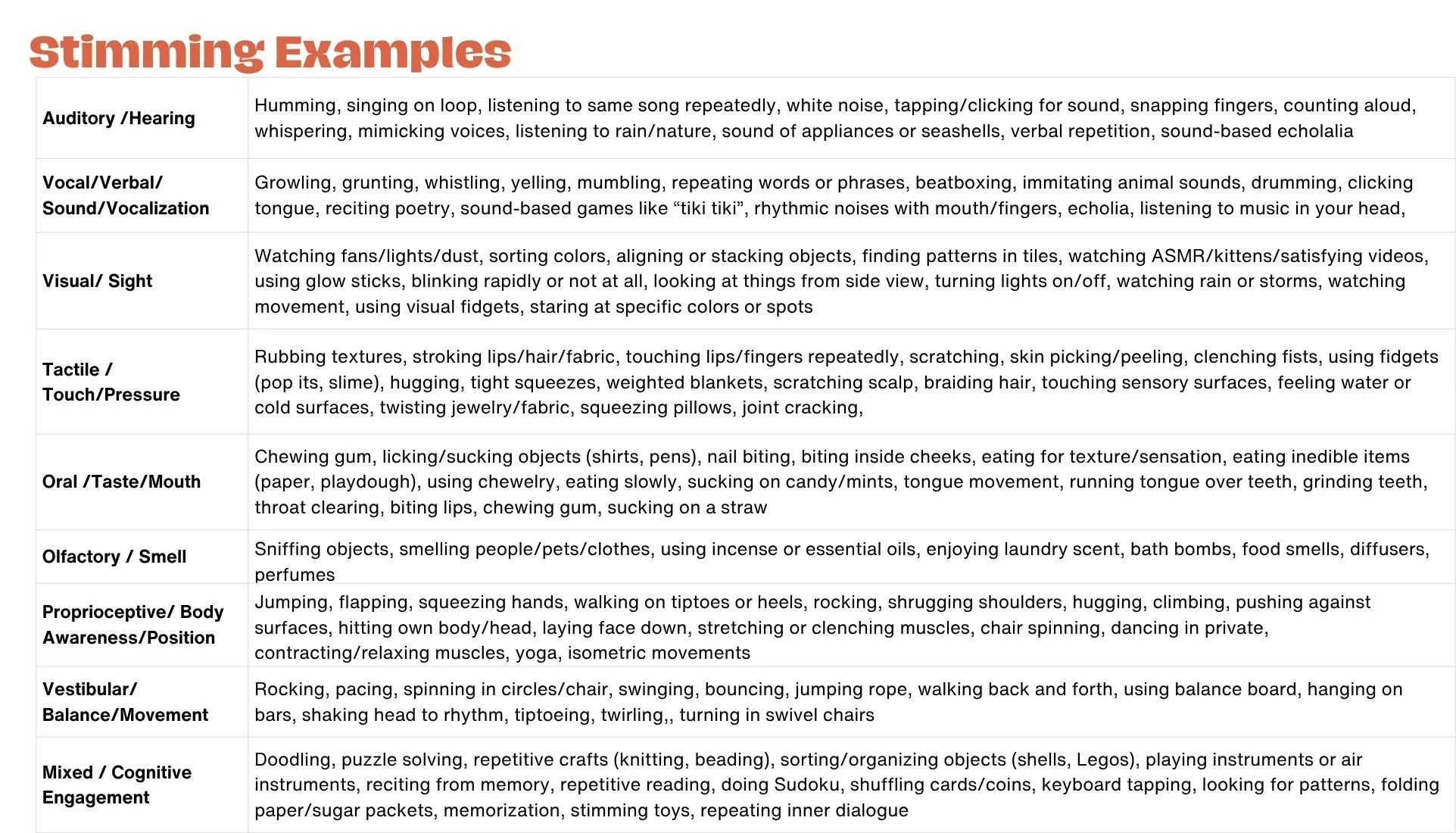
Everyone stims to some degree.
Autistic people often rely on stimming more because our nervous systems have greater sensory regulation demands.
In a world full of unpredictable sensory information, stimming creates something predictable. Something the brain doesn't have to guess about.
Something it can organize around.
Research suggests that stimming may help reduce sensory overload, support attention, improve working memory, release physical tension, and regulate emotional arousal. While researchers are still working to understand all of its functions, the evidence increasingly suggests that stimming often supports self-regulation rather than interfering with it.
Rather than creating chaos, stimming often creates stability.
The question isn't:
"Why are they doing that?"
A more helpful question is:
"What is that behavior helping them accomplish?"
What This Means for Therapy
As both an autistic person and an expressive arts therapist, I don't automatically see behaviors as problems to eliminate.
I see them as communication.
Instead of asking,
"How do we make this behavior disappear?"
I'm more interested in asking,
"What is the nervous system trying to accomplish?"
That shift changes everything.
Rather than working against someone's nervous system, therapy can help people understand how their nervous system works, recognize their sensory needs, develop regulation strategies that fit their lives, and build a life that doesn't require constant masking.
My goal isn't to help autistic people appear less autistic.
My goal is to help them understand themselves more deeply, trust their own experiences, and create lives that feel more authentic and sustainable.
A Different Question
For decades, autism has largely been understood by observing behavior.
But behavior is only the surface.
When we begin with sensory experience instead of outward appearance, stimming no longer looks like a meaningless habit.
It becomes what it has often been all along:
An adaptive strategy that helps the nervous system navigate a world that can feel unpredictable, intense, and overwhelming.
Perhaps the question has never been,
"Why do autistic people stim?"
Perhaps a more helpful question is,
"What can stimming teach us about how this person experiences the world?"
When we approach autism with curiosity instead of correction, we create space for understanding, compassion, and more effective support.
If this resonates with you…
Whether you're an autistic adult exploring your own sensory experiences, a parent trying to better understand your child, or someone looking for neurodiversity-affirming support, you don't have to figure it out alone.
In my practice, I offer expressive arts therapy that recognizes behavior as communication, values sensory differences, and helps people develop strategies that work with their nervous systems— not against them.
If you're curious about working together, I'd love to connect.
References
American Psychiatric Association. (2013). Diagnostic and Statistical Manual of Mental Disorders (5th ed.).
Hull, L., Petrides, K. V., Allison, C., et al. (2017). "Putting on My Best Normal": Social camouflaging in adults with autism spectrum conditions.
Kapp, S. K., Steward, R., Crane, L., et al. (2019). People should be allowed to do what they like: Autistic adults' views and experiences of stimming.
Lawson, R. P., Rees, G., & Friston, K. J. (2014). An aberrant precision account of autism. Pellicano, E., & Burr, D. (2012). When the world becomes too real: A Bayesian explanation of autistic perception.
Raymaker, D. M., et al. (2020). Having all of your internal resources exhausted beyond measure and being left with no clean-up crew: Defining autistic burnout.
Robertson, C. E., & Baron-Cohen, S. (2017). Sensory perception in autism. Nature Reviews Neuroscience, 18(11), 671–684. https://doi.org/10.1038/nrn.2017.112
Interested in working with Darcy? Connect with her at Darcy@RoomToBreatheChicago.Com