
Learning How To Be Anxious
You ever been anxious? Me too. You ever hate feeling anxious? Same here. It’s such a common emotion and, I’ve found, often deeply misunderstood.
Let’s get on the same page. Anxiety is our body’s signal that there is something that threatens to undo us unless we act. Back in the day (I’m talking thousands of years, really), our reptile brain ancestors actually needed anxiety – it was a way to survive, lest we forgot to defend against the hungry tigers lurking in the bushes. I don’t know about you, but I’ve never had to fight a tiger in my life, but I can still feel anxious. So what’s that about?
When I was a wee babe, I could throw a fit like you thought the world was ending. And my parents sure did the best they could. Exasperated, they’d try to comfort me, give me reasons to be happy, food (I was no stranger to hanger), or would just leave me in a room to mellow out. I don’t blame them for wanting a screaming toddler to, please, quiet down, even just a little bit.
Flashforward 20 years or so and folks around me saw me as driven, charismatic, successful. Some of this was certainly borne of my own sense of play and purpose. But some of this was because I had learned that big emotions were things to disappear. I swallowed them down, escaped into my ruminative thoughts, or expressed them in other ways that took me away from the life I had actually wanted to live. And then, through these walls I had built, anxiety came crashing in like a deeply unwelcome Kool-Aid man: OH YEAH.
Anxiety wasn’t warning me about a tiger. It was warning me about emotions that I had labelled as threats, that I had learned to view as too much or unacceptable for the relationships I craved. And instead of challenging that label, I would do everything I could to invalidate and disappear that very signal. I would take walks in nature, listen to relaxation meditations, try to limit screen use. And don’t get me wrong – all of those were great ideas to some extent. But those strategies failed to address the underlying “problem” – those pesky big emotions – and, as a result, I found myself in a never-ending battle with anxiety. Soon enough, I found myself in therapy, because I was just too tired to continue the fight on my own.
There’s a common misconception about therapy: therapy makes you feel better. I am devastated to say that that is not the case. Don’t get me wrong – I think most people would benefit from some therapy and it just so happens that feeling better is often a side effect of therapy, eventually. But that’s not the principal goal. If I might offer a reframe for anyone thinking about working through their anxiety: therapy is learning how to feel our feelings better, no matter how unsavory they might first appear. Working with a therapist often means learning how to accept the big emotions in our bodies or the parts of ourselves that we had to learn to hide, disown, and banish from our waking life – because all the things we’ve been doing to avoid those parts of ourselves often seem to create more trouble than lasting relief. And the first big emotion to really accept is often the anxiety itself.
I can sometimes still hear my younger self when I get anxious: But this sucks so much! I’m supposed to accept it? How do I do that? How do I make it all go away? If this desperation or intolerance resonates with you, it might be because many of us have been taught two things: 1) there is something wrong with us, our negative emotions, or our discomfort; 2) we have to be doing something to fix ourselves. When anxiety creeps up, our learning histories are often the first things to pop up because they once helped us maintain connection with those we loved. If I’m not anxious, sad, angry, annoyed, etc., then I’ll be loved by those important to me. Or, even more sneakily: If I just accept my anxiety, it will go away and then I’ll have room for love. Trying to solve or escape anxiety and those other big emotions ultimately turns into the same invalidation we often experienced in our early lives and learned to perpetuate in ourselves.
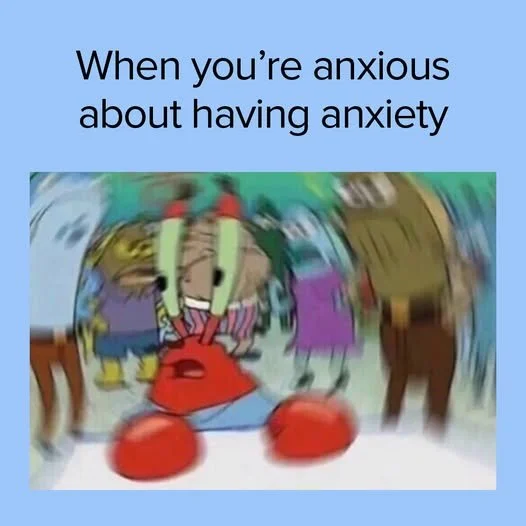
This trap is perhaps familiar to those who have practiced mindfulness meditation. The more you try to achieve a certain internal state of acceptance, the more you try to escape what is actually happening right now, right this second. The more you try to respond in order to escape or find relief from an emotion, the more that emotion seems to stick around. Instead of this is anxiety, we may find ourselves saying this is anxiety so I’m accepting it now, right? It should go away, please go away so things can be a little bit more peaceful, ugh this sucks, it’s not going away, and I’m getting more anxious.
And therein lies the rub: acceptance might not be doing something. In fact, what if acceptance isn’t doing something, but doing nothing? Anxiety’s power often lies in the sense of urgency, the seeming necessity for action. And the more we feed into doing something to make an invisible, internal threat go away, the louder the threat becomes – because, somehow, doing something is never quite enough. To be sure, acceptance as a non-response can be challenging and counter intuitive. And that’s why mindfulness meditation often works well with therapy; when we find ourselves in an intractable, constant struggle with certain emotions, thoughts, and/or identities, therapy provides a space to just let them be, even just briefly, so that we can see them clearly, acknowledge their existence, and ultimately reorient to the lives we want to live.
For some, I am the bearer of bad news: completely eliminating anxiety is rarely an option. And perhaps this is a good thing for when literal or metaphorical tigers actually do show up! Anxiety isn’t always just an old wound about self-worth playing itself out; it might be telling us something true about the oppressive or precarious conditions we find ourselves in – and that’s worth taking seriously on its own terms. The key is this: accepting a feeling in your body is not the same as accepting the conditions that produced it. In this sense, a non-response isn’t ignoring the threat of structural violence; it is about the quality of our relationship to our experience. From here, we can begin to listen or get curious about what anxiety is trying to say, by letting it pass through on its own time as we continue to live by our aspirations, values, and commitments. Through my work with clients and my own lived experience, I offer this consideration: perhaps we can learn alternative ways of being anxious rather than trying to exile it like those other invalidated parts of ourselves.
If you find this resonates with you, do consider giving therapy a try, engaging in contemplative practice – be that yoga, mindfulness meditation, or artistic practice – or attending a workshop (coming this August at Room To Breathe!). Really it’s up to you. In the end, be with whatever helps you recognize that you are more than your anxiety and that your anxiety can belong to the world, just as much as you.
Interested in working with Em? Connect with them at Sandberg@RoomToBreatheChicago.Com
Join Em’s upcoming online workshop Living With Good Enough: A Workshop on Performance Anxiety on Sunday, August 16th from 2pm-4pm.